






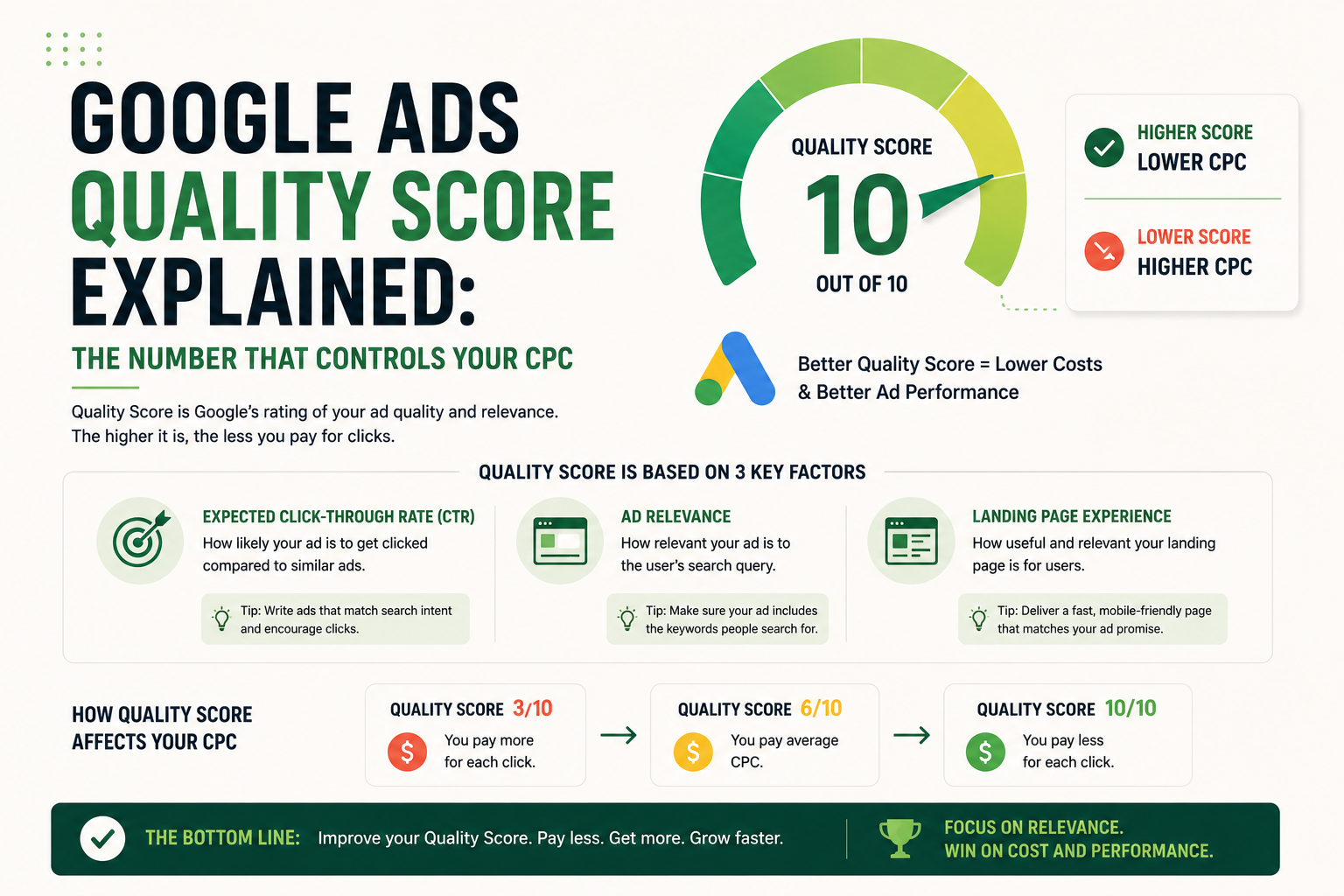
Quality Score is one of the most powerful levers in Google Ads - and one of the most misunderstood. It is a 1-to-10 rating that Google assigns to each keyword in your account, based on the relevance of your ads and the quality of your landing page experience. It directly determines how much you pay every time someone clicks your ad. A higher Quality Score means a lower cost per click for the same ad position. A lower Quality Score means you are paying a premium to compete for positions that a well-optimised account reaches at a fraction of the cost.
In a well-managed Google Ads account, Quality Score improvements can reduce cost per click by 20 to 50 percent over time - delivering the same or better performance at dramatically lower spend. Understanding how it works and how to improve it systematically is one of the highest-ROI activities in paid search management.
How Quality Score Actually Works
Quality Score is calculated from three components, each rated as "Above Average," "Average," or "Below Average": Expected Click-Through Rate (eCTR), Ad Relevance, and Landing Page Experience. These three factors are weighted by Google into a composite 1-10 score. Google's published guidance suggests eCTR has the highest weight, followed by landing page experience, with ad relevance having the smallest individual contribution.
Expected Click-Through Rate (eCTR)
eCTR is Google's prediction of how likely your ad is to receive a click when shown for a given search query - relative to other ads competing for the same query. It is based on your historical CTR, adjusted for factors like ad position. An eCTR rated "Below Average" means Google predicts your ad will click through at a lower rate than the average for ads appearing in the same position. This is the signal that your ad copy is not resonating with the search intent, or that your ads are showing for queries they don't closely match.
Ad Relevance
Ad relevance measures how closely your ad copy matches the intent behind the keyword triggering the ad. The most direct fix for low ad relevance is ensuring your ad headlines contain the keyword (or a close semantic match) and that the ad copy speaks directly to the user's search intent. Generic ad copy that could apply to any keyword in a broad ad group will consistently score "Below Average" on relevance.
Landing Page Experience
This component evaluates whether the landing page you send users to is relevant, useful, and easy to navigate. Signals Google uses include the page's relevance to the keyword and ad, its load speed, its mobile usability, and how quickly users leave after arriving (bounce rate as a proxy for dissatisfaction). Sending all traffic from a keyword-specific ad to a generic homepage will almost always produce a "Below Average" landing page experience rating.
Diagnosing Your Quality Score Issues
How to Find Quality Score in Google Ads
In the Google Ads interface, navigate to Keywords in the left menu. Add the Quality Score column, then add the three component columns (Expected CTR, Ad Relevance, Landing Page Experience). Sort by Quality Score ascending to find your worst-performing keywords. Focus improvement effort on high-spend, low-Quality-Score keywords first for maximum ROI impact.
The Most Common Quality Score Patterns
In Google Ads account audits, we consistently see the same patterns. Large, unfocused ad groups with dozens of loosely related keywords in a single group - the ads can't possibly be relevant to all of them. Generic ad copy that doesn't echo the keyword or speak to specific intent. Traffic directed to a homepage or category page instead of a purpose-built landing page that mirrors the ad's promise. These are structural problems that require structural fixes, not bid adjustments.
Practical Steps to Improve Your Quality Score
- Restructure into tighter ad groups. Each ad group should contain a tightly themed set of keywords where the same ad is genuinely relevant to all of them. The ideal is one to three keywords per ad group (single keyword ad group, or SKAG) for your highest-spend terms. This makes it easy to write specific, high-relevance ad copy and ensures your eCTR data is clean.
- Write ad copy that mirrors the keyword. Use the primary keyword in at least one Responsive Search Ad headline. Speak directly to the searcher's intent in the description lines. If someone searches "email marketing software for e-commerce," the headline should say something like "Email Marketing Built for E-Commerce," not "Award-Winning Email Platform."
- Build dedicated landing pages for each ad group. The landing page a user arrives on should feel like a direct continuation of the ad. Same language, same offer, same intent. If your ad promises a free audit, the landing page should be about the free audit, not your full service offering.
- Improve landing page speed and mobile experience. Google's landing page experience rating uses real-user data. A landing page that loads in five seconds on mobile will consistently score poorly, regardless of how relevant its content is.
- Use negative keywords aggressively. Ads showing for irrelevant queries drag down your eCTR even if no one clicks them. A poor expected CTR on irrelevant impressions suppresses your Quality Score. Regular search term reviews and negative keyword additions are one of the highest-impact, lowest-effort optimisations in Google Ads.
"Quality Score improvements are compounding investments. A keyword at score 7 costs you roughly 17% less per click than the same keyword at score 5. Over a year's worth of spend, that difference is substantial - and it compounds as your account history improves."
- Saleh Zaqout, Account Director at Pixelique Digital
Quality Score improvement is not a one-time project - it is ongoing account hygiene. The accounts that consistently achieve the lowest CPCs in competitive industries are those where Quality Score optimisation is a regular part of campaign management. If you want a Google Ads audit that includes a full Quality Score diagnosis and improvement roadmap, get in touch with our team.