





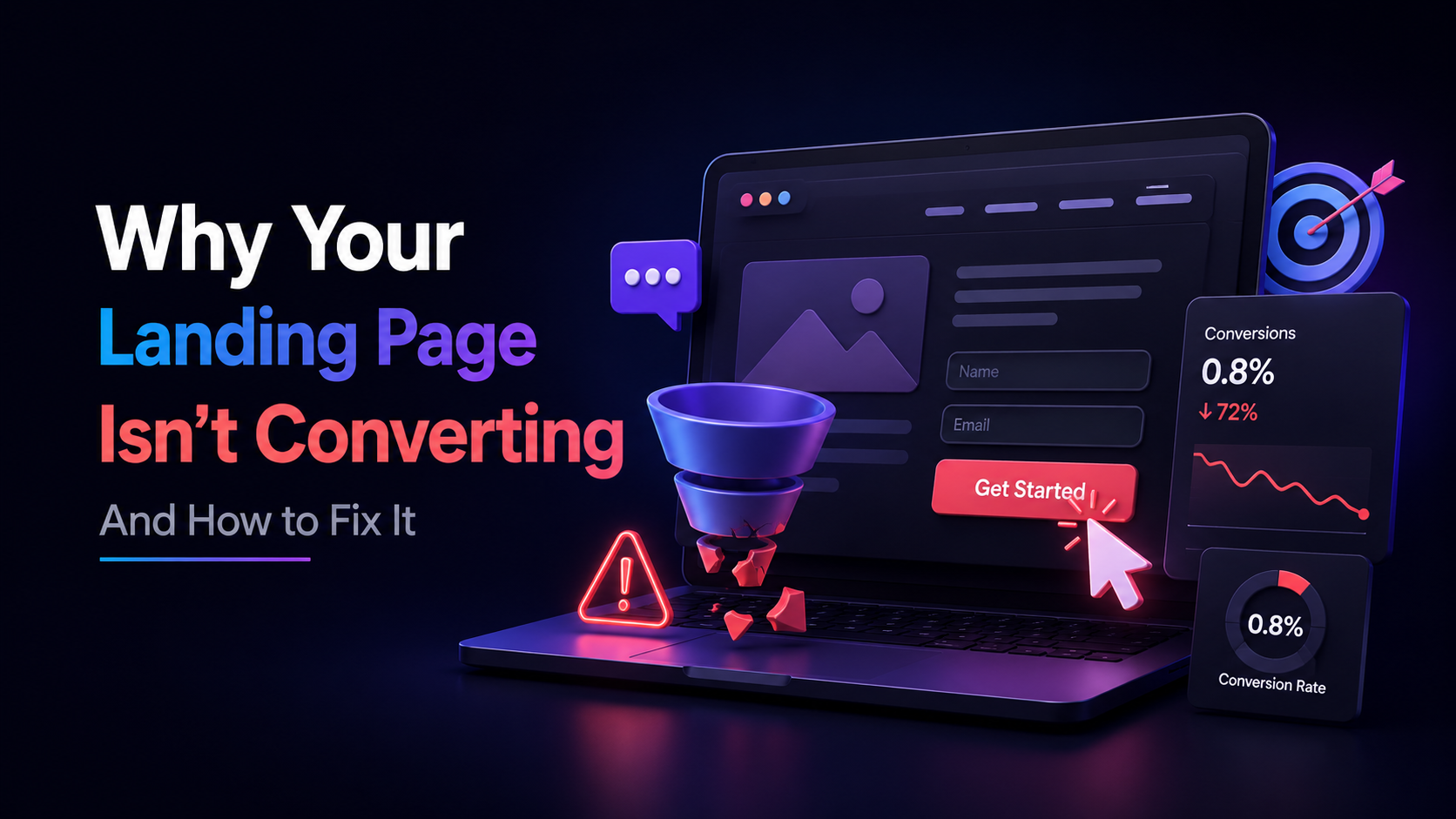
You've done the hard part. You've built the traffic - from paid search, social media, SEO, or email. People are arriving at your landing page. And then they leave without converting. This is one of the most common and costly problems in digital marketing, and in almost every case it is fixable once you correctly diagnose which element is failing.
Landing page conversion problems rarely come down to one cause. They are usually the result of several smaller failures stacking: a headline that doesn't match the ad, a form with too many fields, a value proposition buried below the fold, a page that loads in four seconds on mobile. Identifying and fixing each layer is what moves conversion rates from one or two percent to five, eight, or higher.
The Message Match Problem
The most common landing page failure we diagnose in CRO audits is message mismatch. A user clicks an ad that promises "Free website audit in 24 hours" and arrives on a page that talks about all your services with no mention of the specific offer. The disconnect is immediate and the user leaves. Message match means the headline of your landing page should directly echo the language of the ad or link that brought someone there.
This applies across every traffic source. If your email campaign focuses on a summer discount, the landing page should lead with that discount - not your generic homepage or a category page. If a paid search ad targets "email marketing for e-commerce," the landing page should speak specifically to e-commerce email marketing, not email marketing in general. The closer the match between the promise and the destination, the higher the conversion rate.
How to Audit Your Message Match
Take your five highest-traffic landing pages. For each, identify the primary traffic sources and the exact language used in the ads or links driving that traffic. Then read the first sentence of your landing page headline and subheading. Could a visitor who arrived from that ad immediately confirm they are in the right place? If the answer is "possibly" or "no," you have a message match problem, and fixing it is typically one of the highest-impact CRO changes you can make.
Value Proposition and Hero Section
Users make their first decision about a landing page in under five seconds. The above-fold section - everything visible before the user scrolls - needs to clearly communicate what you offer, who it's for, and why it's different. Most landing pages fail at this because they lead with a generic headline ("Welcome to our digital marketing agency"), a vague benefit ("We help businesses grow"), or company-focused copy ("We've been in business for 10 years").
The Above-Fold Checklist
Your hero section needs to answer three questions instantly: What is this? Who is it for? What happens next? If a stranger cannot answer all three within five seconds of arriving, the section needs work. Everything below the fold should support the decision to take the action introduced above the fold.
Writing Headlines That Convert
The most effective landing page headlines are specific, outcome-focused, and written from the visitor's perspective. "Get 30% more leads from your existing website traffic" outperforms "Expert digital marketing solutions" in virtually every test we run. Specificity builds credibility. An outcome tells the visitor what's in it for them. Visitor-perspective language ("your traffic," "your website") signals that the page is about them, not about the company selling the service.
Removing Friction From the Conversion Path
Friction is anything that makes the conversion action harder or more uncertain. The most common friction points in landing pages are: long forms, unclear CTAs, missing trust signals, slow load speed, and poor mobile experience.
Form Length and Conversion Rate
Every additional field on a form reduces conversion rate. The data is consistent across industries: reducing a contact form from eight fields to three fields typically doubles or triples submission rate. Ask only for what you genuinely need to follow up. Name and email is almost always sufficient for a first touch. Phone number, company size, budget range, and project description can be gathered after the conversion, not before it.
CTA Clarity and Specificity
Generic CTAs underperform specific CTAs in every test we run. "Submit" converts worse than "Get My Free Audit." "Learn More" converts worse than "See How It Works." "Contact Us" converts worse than "Talk to a Specialist." The CTA should tell the visitor exactly what happens when they click, and it should feel like a benefit, not a transaction.
Trust Signals That Reduce Risk Perception
Conversion hesitation is often about perceived risk. The visitor is asking: "Is this safe? Is this company legitimate? Will this be worth my time?" Trust signals - client logos, case study numbers, testimonials with full names and companies, security badges, money-back guarantees - directly reduce this hesitation. Place trust signals near your CTA, not buried at the bottom of the page.
"Most landing pages are written by people who already know what the company does and already trust it. The visitor has neither of those things. Write for the visitor, not for yourself."
- Roksana Miszczak, Digital Marketing Strategist at Pixelique Digital
Testing Your Way to Higher Conversion
Once you've addressed the structural problems - message match, value proposition, friction reduction - the next phase is systematic testing. A/B testing allows you to make evidence-based improvements rather than guessing which version performs better.
- Test one element at a time. Changing the headline, the CTA, and the hero image simultaneously tells you that something worked but not what. Isolate variables.
- Run tests until statistical significance. A test that runs for three days with 200 visitors is not meaningful. You need sufficient traffic and time to account for day-of-week variation and to reach 95% significance.
- Prioritise high-impact elements first. Headline, hero image, CTA copy, and form length have the highest impact on conversion rate. Button colour and minor copy tweaks have a much smaller effect.
- Document and build on results. A test result is only valuable if it informs the next test. Keep a record of what you tested, the hypothesis, the result, and what you concluded.
Landing page optimisation is a compound process. Each improvement builds on the last, and the cumulative impact over six to twelve months is typically dramatic. If you want an expert review of your highest-traffic landing pages with specific recommendations, request a free CRO audit from our team.