
 United Arab Emirates

"Should we be on Google or Meta?" It's one of the first questions we hear from new clients, and it's a completely reasonable one. Both platforms command enormous ad spend globally, both can deliver exceptional results, and both have passionate advocates. But spending on the wrong one for your business, or splitting a limited budget before you're ready, is one of the most common and costly mistakes in digital advertising.
The honest answer is that there's no universal right choice. But there is a clear framework for making the right choice for your specific business, your audience, and your growth stage. Here it is.
The Fundamental Difference: Intent vs. Discovery
Before you can decide where to spend, you need to understand what each platform fundamentally does, because they operate on completely opposite principles.
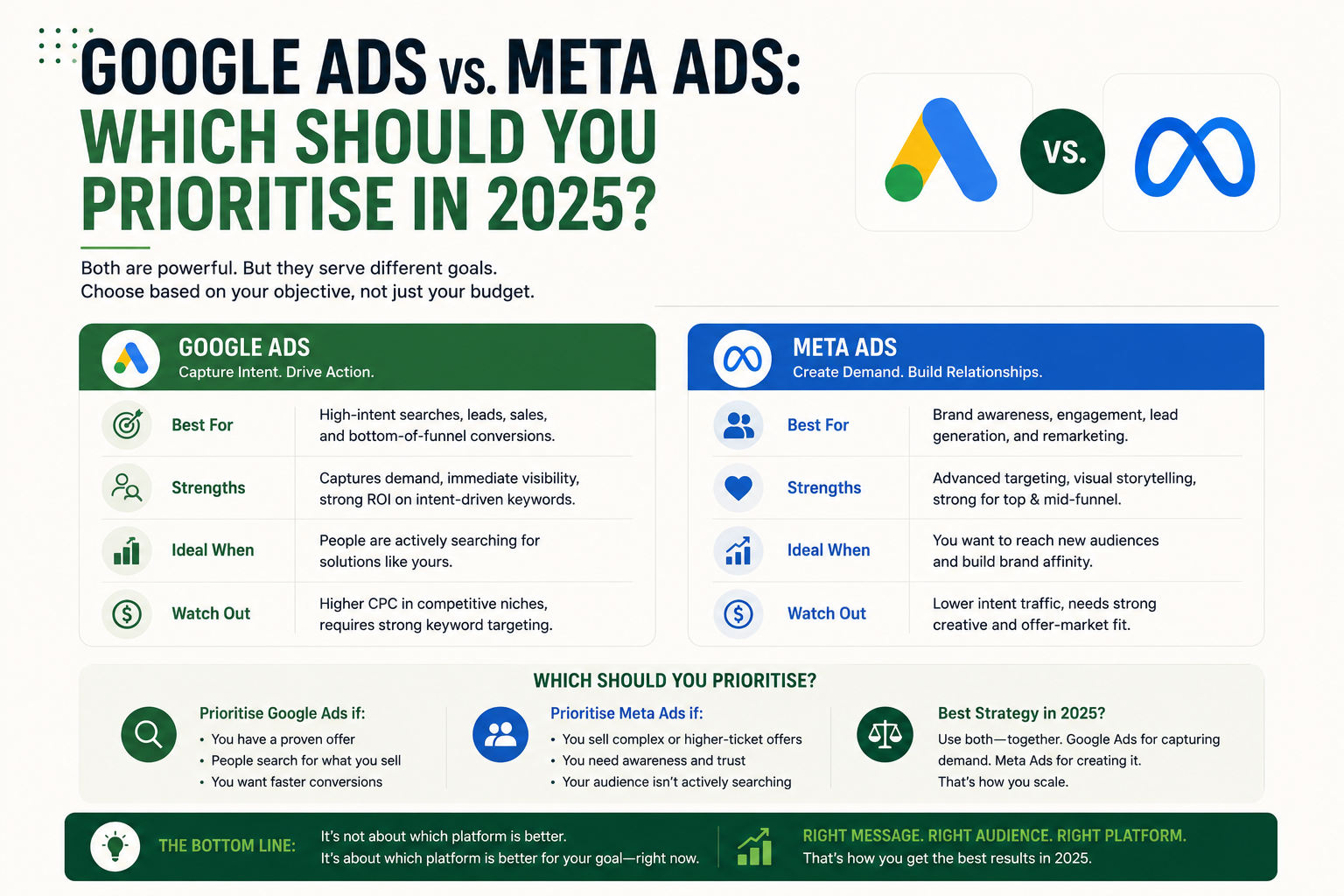
Google Ads is a demand-capture platform. When someone types a query into Google, they already have intent. They're actively looking for something, a product, a service, an answer, a solution to a problem. Your ad intercepts that existing demand at the exact moment it's expressed. This is why Google is often described as the most efficient direct-response channel in digital marketing: you're not persuading someone to want something; you're simply making sure they find you when they already do.
Meta Ads, across Facebook and Instagram, works on the opposite principle. There is no search intent. Users are scrolling through content they came to consume, not to shop. Meta's job is to interrupt that scroll with something relevant enough and compelling enough to create desire that didn't exist a moment earlier. This is demand creation, also called interruption marketing, and it requires a fundamentally different creative strategy: you must earn attention before you can earn a click.
Neither approach is better in the abstract. But one will be significantly better for your business right now, based on what your audience is already doing and what your product requires.
Google Ads: When Search Intent Is Your Greatest Asset
Google Ads performs best when your potential customers are actively searching for what you offer. If people are already typing queries that describe your product or service, Google lets you appear in front of those high-intent prospects at the precise moment they're ready to act. The value of that moment is hard to overstate, conversion rates on high-intent search traffic routinely outperform display or social by a factor of three to five times.
The platform also offers exceptional control over budget efficiency through keyword-level bidding. You can allocate spend with granularity: more toward proven converters, less toward exploratory terms, nothing toward irrelevant traffic once your negative keyword lists are properly built out. For businesses with clear, searchable offerings and reasonable search volume, that level of precision is extremely powerful.
Google Ads also extends well beyond search. YouTube pre-roll, Display Network remarketing, Performance Max campaigns, and Shopping ads all sit within the Google ecosystem, giving you the ability to reach users at multiple stages of the funnel from a single platform. Our paid advertising team manages full-funnel Google strategies that move prospects from first search through to conversion.
"The businesses that consistently achieve the best ROAS on paid media aren't the ones with the biggest budgets, they're the ones who understand which platform their customers actually use when they're ready to buy, and they put their money there first."
- Roksana Miszczak, Digital Marketing Strategist at Pixelique Digital
Meta Ads: When You Need to Create the Demand
Meta Ads excels in a different scenario: when your product or service is something people don't yet know they need, when search volume for your category is low or nonexistent, or when your business model benefits from broad audience discovery and visual storytelling. For direct-to-consumer brands, lifestyle products, fashion, food, and many e-commerce verticals, Meta can drive extraordinary volume that Google simply cannot replicate because the search demand doesn't exist at scale.
The platform's audience targeting capabilities remain unrivalled for interest and behaviour-based segmentation, even as privacy changes have eroded some of the precision available a few years ago. Lookalike audiences built from your best existing customers are still among the most effective prospecting tools in digital advertising, particularly for businesses that have enough first-party data to build meaningful seed audiences.
Meta also shines for retargeting. If you have web traffic that didn't convert, Meta lets you follow those prospects across Facebook and Instagram with sequential creative that addresses objections, reinforces the offer, and brings them back. Paired with a strong social media marketing strategy, Meta advertising becomes part of a broader brand-building and conversion system rather than a standalone channel.
Pro Tip
On Meta, your creative is your targeting. The algorithm has become remarkably good at finding the right people for a given ad, but only if the ad itself signals clearly who it's for. Broad audiences with highly specific creative often outperform tightly targeted audiences with generic messaging.
Which Platform Wins for Your Industry?
While every business is different, clear patterns emerge across industries that should inform your platform prioritisation, especially when budget is limited and you need to pick a starting point.
Google Ads tends to outperform for:
- Professional services and B2B, buyers are actively searching for solutions, often with specific intent and urgency
- High-ticket considered purchases, legal, financial, medical, real estate, SaaS, where the decision process starts with a search
- Local service businesses, plumbers, dentists, accountants, where proximity and immediacy matter and Google Maps integration drives call volume
- Products with strong keyword demand, where the category is well established and people already know what they're looking for
Meta Ads tends to outperform for:
- E-commerce and direct-to-consumer brands, especially those with visually compelling products where scroll-stopping creative can drive impulse purchases
- New product categories or novel offerings, where educating and inspiring the audience is required before they'd think to search
- Subscription and community products, where awareness and desire must be built before conversion
- Brands with strong creative assets and a defined visual identity, where the Meta format is a natural fit for storytelling
If you're unsure where your business falls, get in touch, we'll give you an honest assessment based on your market and growth stage, with no obligation.
The Case for Running Both Platforms in Parallel
For businesses that have passed the early growth stage and have both the budget and the data to support it, running Google and Meta in parallel creates a full-funnel advertising system that neither platform can achieve alone. Google captures the buyers who are ready now. Meta builds the audience of future buyers who aren't yet searching but will be, and it keeps your brand visible during the consideration period between first exposure and purchase decision.
The combination also provides a natural cross-channel signal for attribution. Users who see your Meta ad and then search for your brand on Google are measurably more likely to convert than cold search traffic alone. This brand-search uplift is one of the strongest arguments for maintaining Meta investment even when the direct attribution numbers look modest on their own.
Running both platforms also gives you resilience. Algorithm changes, policy updates, and competitive bidding shifts can impact performance on any single platform at any time. Diversification across Google and Meta means a sudden change on one platform doesn't halt your pipeline entirely while you adapt.
How to Allocate Budget Between Google and Meta
If you're starting out or working with a constrained budget, the allocation decision is straightforward: invest first in the platform that matches where your buyers already are in their journey. For most service businesses and B2B companies, that means starting with Google. For most e-commerce and consumer brands, that means starting with Meta. Build one channel to a point of confidence and profitability before splitting your attention and budget.
Once you're ready to run both, a sensible starting split for most businesses is 60% toward the primary intent-matching platform and 40% toward the other. This reflects the asymmetry in immediate return, the platform aligned with your buyer's intent will nearly always produce better short-term ROAS, while still giving the secondary platform enough budget to generate meaningful data.
From there, let performance guide rebalancing. Review results at 30-day intervals, not weekly, paid media needs time to accumulate data before drawing conclusions. Look at cost-per-acquisition and contribution margin by channel, not just click volume or CTR. Shift budget toward what's producing results, and reinvest the efficiency gains into testing new audiences, creatives, or campaign types on the platform where you've already found traction.
The goal isn't to find one winner and abandon the other, it's to build a system where both platforms work together, each doing the job it does best, at a budget split that reflects the evidence from your own account data rather than a generic formula.

