

 Germany

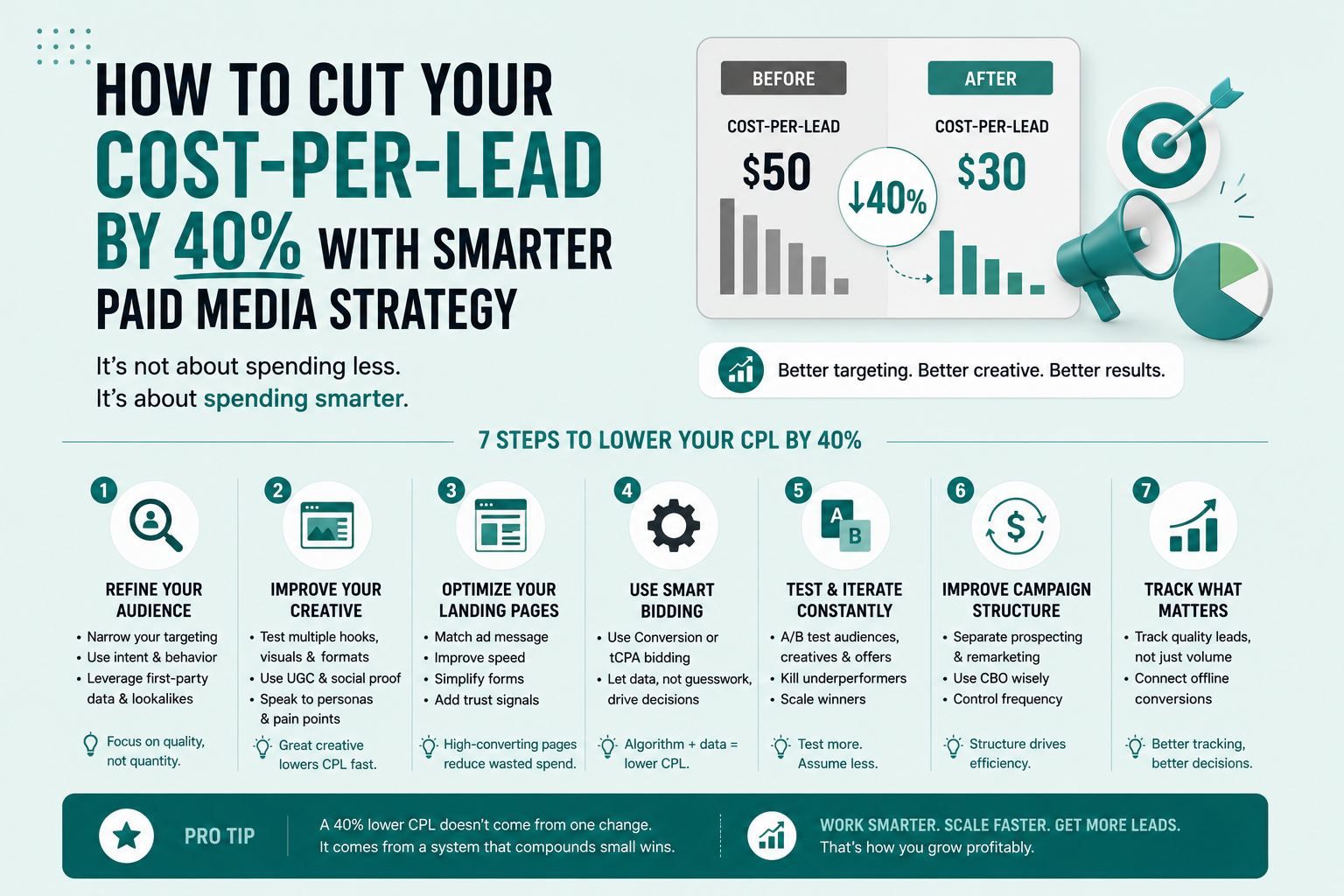
Most paid media budgets are wasted before they even reach the right audience. We've audited hundreds of ad accounts over the years, and the pattern is almost always the same: broad targeting, poor account structure, weak creatives, and zero systematic testing. The result? Sky-high cost-per-lead numbers that make growth feel impossible.
The good news is that cutting your CPL by 40% or more doesn't require a bigger budget, it requires smarter allocation of the budget you already have. Here's the exact framework we use with every new client from day one.
Key Takeaway
In our experience, 60–70% of a typical ad budget is spent on under-performing placements, audiences, or creatives that a proper audit would immediately identify and cut.
Step 1: Audit before you optimise
You can't fix what you can't measure. The first thing we do with any new client is a full account audit, not just a high-level performance review, but a granular breakdown of spend by campaign, ad set, placement, device, time of day, and creative.
Common findings at this stage:
- Significant budget going to audience segments with conversion rates 3–5× lower than top segments
- Mobile placements burning budget with minimal conversions while desktop converts at half the cost
- Campaigns running 24/7 when 80% of conversions happen in a 6-hour window
- Ad creatives that haven't been refreshed in months (ad fatigue is real)
- Broad match keywords without proper negative keyword lists bleeding budget into irrelevant searches
The audit alone typically reveals 30–40% in immediate savings, budget that can be reallocated to what's actually working.
Step 2: Fix your account structure
A well-structured account gives you control. A poorly structured one means you're fighting the algorithm instead of working with it. The principles are straightforward, but they're consistently ignored.
For Google Ads
Separate campaigns by intent signal. Branded keywords, competitor keywords, and generic category keywords should never share a campaign, they have completely different CPL targets and bidding strategies. Mix them together and your bids optimise for the wrong thing.
For Meta Ads
Resist the temptation to over-segment at the ad set level. Meta's algorithm needs data to optimise, too many ad sets with low volume splits the learning across segments and none of them ever exits the learning phase properly. Consolidate, then test.
"We collapsed a client's 47 ad sets into 8 consolidated audiences. CPL dropped 38% in the first three weeks as the algorithm had enough data to actually learn."
- Roksana Miszczak, Digital Marketing Strategist at Pixelique Digital
Step 3: Treat creative as a performance lever
Creative is the single biggest variable in paid social performance. The audience, the bid strategy, the campaign structure, all of that matters, but the ad creative is what determines whether someone stops scrolling or keeps going.
Our creative testing process:
- Launch 4–6 creative variants per audience in the first week, different hooks, formats, and value propositions
- Cut everything below a threshold CPL after 3–5 days and 500+ impressions per variant
- Scale the winning creative while simultaneously testing a new challenger batch
- Refresh creative every 3–4 weeks before fatigue sets in, watch your frequency metrics
Step 4: Choose the right bidding strategy
Automated bidding strategies are powerful, but only when your account has enough conversion data to feed the algorithm. Here's a simple rule of thumb:
- Under 30 conversions/month: Use manual CPC or target impression share. The algorithm has nothing to learn from.
- 30–100 conversions/month: Target CPA with a conservative target. Give it room to learn.
- 100+ conversions/month: Maximise conversions or Target ROAS. Now you're giving the algorithm what it needs.
Common Mistake
Switching to Target CPA too early, when the account only has 8–10 conversions per month, forces the algorithm to make decisions with insufficient data, driving CPL up rather than down.
Step 5: Don't ignore your landing pages
Paid media is only half the equation. If you drive highly qualified traffic to a slow, confusing, or unconvincing landing page, your CPL will stay high no matter how well-optimised the campaign is. We regularly see clients who have great campaigns but a 1–2% conversion rate on a page that should be converting at 5–8%.
Minimum landing page requirements for effective paid campaigns:
- Page load time under 2.5 seconds on mobile (measure with PageSpeed Insights)
- A single, clear CTA above the fold that matches the ad's promise exactly
- Social proof visible within the first scroll, reviews, client logos, or results stats
- Form with no more than 4 fields, every extra field drops conversion rate by ~10%
- Mobile-first layout, most of your paid traffic is on mobile
What results to expect
Following this framework consistently, clients typically see:
- 20–30% CPL reduction within the first 30 days from structural fixes alone
- An additional 15–25% reduction over months 2–3 as creative testing matures
- Compounding improvements through months 4–6 as bidding algorithms accumulate data
The key word is consistently. Paid media optimisation isn't a one-time project, it's an ongoing process of testing, learning, and iterating. The brands that win at paid media are the ones that treat it as a system, not a campaign.
If you'd like us to run this audit on your account and identify where your budget is being wasted, get in touch, the first audit is on us.