
 Saudi Arabia

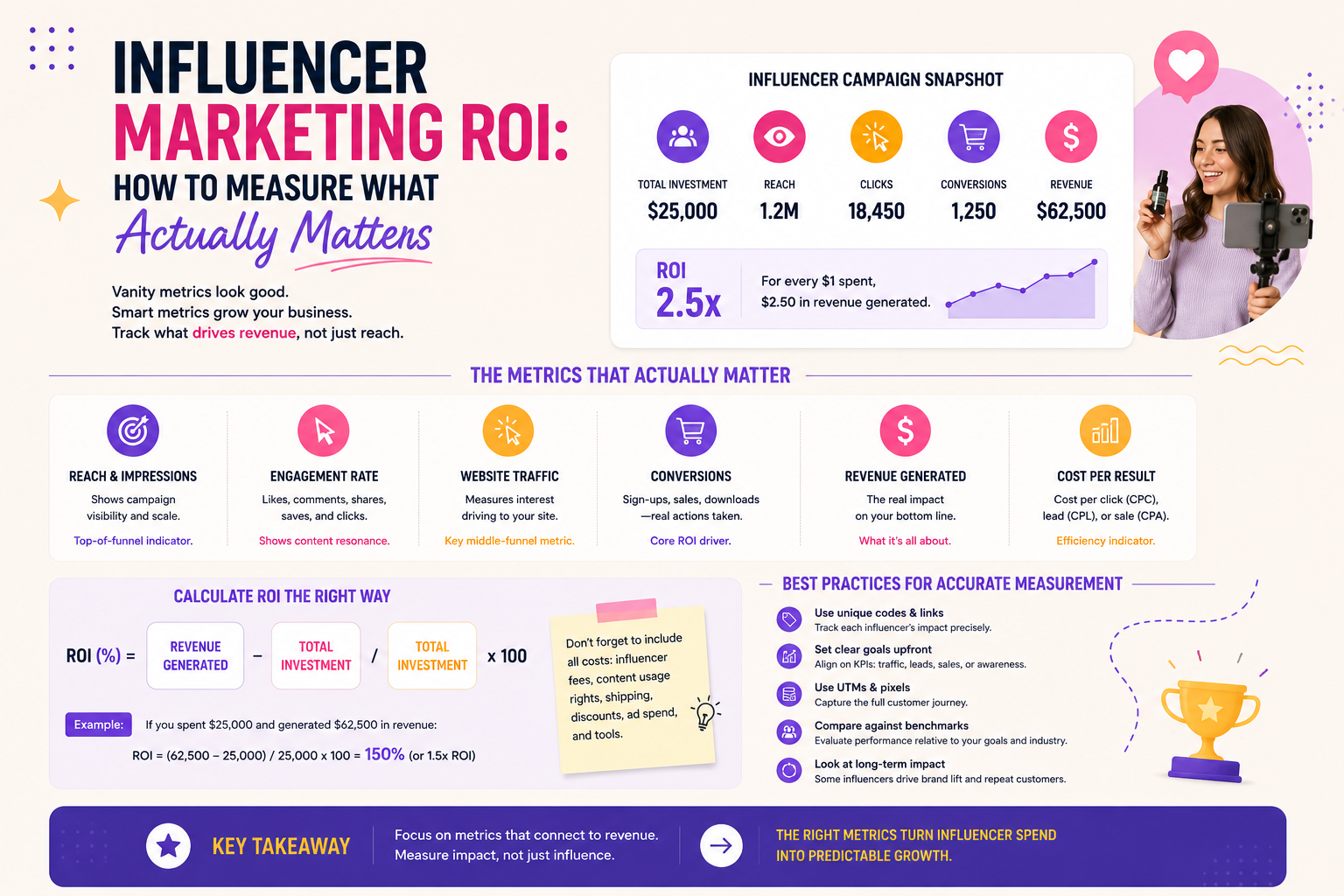
Influencer marketing divides marketers more than almost any other channel. Some businesses report it as their highest-performing acquisition channel. Others describe spending significant sums on campaigns that generated impressive reach metrics and almost no revenue. The difference rarely comes down to which influencers they worked with. It comes down to whether they had a measurement framework before the campaign started.
The brands succeeding with influencer marketing in 2026 are treating it like any other performance channel: clear objectives, specific KPIs defined in advance, tracking in place before launch, and a post-campaign analysis that informs the next investment decision. The ones failing are treating it like a press release - producing coverage and hoping it translates to commercial outcomes without measuring whether it does.
Setting the Right Objectives Before You Start
The first question to ask about any influencer campaign is not "who should we work with?" - it's "what specific business outcome are we trying to achieve?" This sounds obvious, but the majority of influencer briefs we review don't answer it. They describe the campaign (partner with five creators in the fitness space, produce ten videos), not the objective (increase trial sign-ups for our new supplement by 15% in Q3).
Influencer campaigns can effectively serve several different objectives, but they can't serve all of them equally well simultaneously. Awareness, brand association, direct sales, and UGC content generation each require different creator selection criteria, different content briefs, and different success metrics. Clarity on the primary objective determines everything that follows.
Choosing Creators Based on Data, Not Aesthetics
The instinct to choose influencers whose aesthetic matches your brand is understandable but often leads to poor campaign performance. Aesthetic fit is table stakes - the real selection criteria should be audience match and engagement quality.
Creator Selection Criteria That Predict Performance
Audience demographic match (are their followers your actual target customers?), engagement rate adjusted for audience size (larger accounts naturally have lower rates - benchmark against peers), comment quality (are comments genuine conversation or generic emojis?), and past campaign performance where available. Follower count is the least predictive metric for campaign ROI.
Micro-Influencers vs Macro-Influencers
For direct response objectives - driving traffic, sign-ups, or sales - micro-influencers (10,000 to 100,000 followers) almost consistently outperform macro-influencers on a cost-per-action basis. Their audiences are more niche and engaged, and the trust relationship between creator and follower is stronger. For awareness objectives - reaching the broadest possible audience with a brand message - macro-influencers or celebrity partnerships may be more efficient at scale. Match the creator tier to the objective, not to the budget.
Measurement Frameworks That Work
The fundamental measurement challenge with influencer marketing is that much of its impact is indirect. Someone sees a Reel featuring your product, doesn't click immediately, but searches for your brand three days later. Last-click attribution assigns this to branded search, not to the influencer campaign. Getting closer to the true contribution of influencer activity requires layered measurement.
Direct Tracking Methods
- Unique discount codes per creator. Attributing purchases made with a creator's unique code gives you a clean, direct measure of that creator's commercial impact.
- UTM-tagged landing pages per creator. Each creator links to a unique UTM-tagged URL, giving you traffic, engagement, and conversion data per creator in Google Analytics.
- Short links per campaign. Use a URL shortener with tracking to see click volume directly from creator content, even when UTM parameters aren't clickable (e.g. in Instagram bio links).
Indirect Measurement Methods
- Branded search volume. Monitor Google Search Console and Google Trends for your brand name before, during, and after influencer campaigns. A significant uplift in branded searches correlates with influencer-driven awareness.
- New visitor traffic. Monitor direct and organic traffic to product or landing pages during and immediately after campaigns for uplift above baseline.
- Social listening. Track mentions and sentiment for your brand or product before and after campaigns to measure the earned conversation generated.
"The brands getting the best influencer ROI are the ones who treat it like a paid channel - with budgets, targets, tracking, and post-campaign analysis. The ones losing money treat it like an experiment with no hypothesis."
- Roksana Miszczak, Digital Marketing Strategist at Pixelique Digital
Influencer marketing, when structured correctly, can be one of the most cost-efficient ways to reach new audiences and build trust at scale. When structured poorly, it is one of the most efficient ways to burn marketing budget with nothing to show for it. If you want help building an influencer strategy with proper measurement built in from the start, speak to our team.