

 Germany

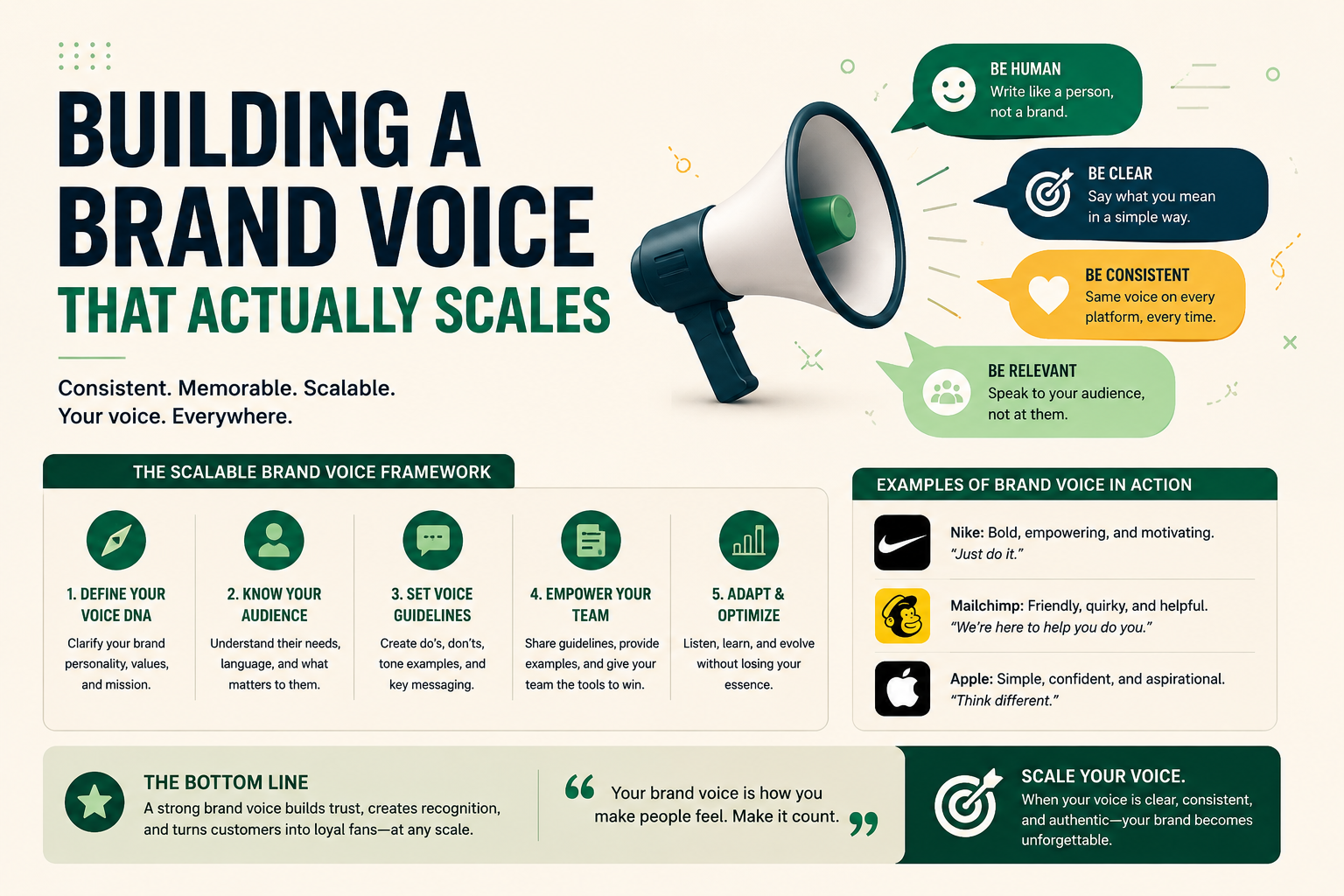
Most brand voice documents are forty-page PDFs that look impressive in a strategy deck and then live untouched on a shared drive. They contain abstract adjectives ("confident yet approachable," "bold yet humble") that mean nothing in practice, and elaborate frameworks that nobody on the team can recall when they're actually writing an email at 4pm on a Wednesday.
The brands with consistent, recognisable voice across email, ads, social, and web are not the ones with the longest brand books. They are the ones with voice frameworks short enough to memorise and specific enough to apply. Here's how we build them.
What Brand Voice Actually Is
Brand voice is the consistent personality your brand expresses in language, across every customer touchpoint, written by every team member, regardless of which platform they're on. It is what makes your customer recognise an email from your brand without seeing the logo. When voice is strong, customers describe the brand the same way colleagues describe a person they know well: with specific traits, distinctive phrases, characteristic responses to situations.
Voice is not the same as tone. Voice is constant, the personality. Tone shifts with context, formal in a contract, casual in a community Slack, urgent in a recovery email. A good voice framework defines both: who the brand is (voice) and how that personality adapts to different situations (tone).
Audit Your Current Voice First
Before defining what your voice should be, document what it currently is, across the messy, distributed reality of your existing content. Pull twenty pieces of recent customer-facing writing: three emails, three social posts, three ad headlines, three landing pages, three help articles, three sales emails, two error messages, and a contract. Read them as a stranger would.
You will find inconsistency: some pieces sound formal, some sound casual; some are warm, some are clinical; some have personality, some are generic. The audit exposes the gap between what people think the voice is and what it actually shows up as in the wild. That gap is what the framework is designed to close.
The Four Dimensions of Voice
The framework that consistently produces usable voice guides has four dimensions. Each is a spectrum, and each brand sits at a specific point on it. The point itself does not matter, the consistency does.
- Formal ↔ Casual. Are we precise and structured, or relaxed and conversational? Bank or beach club?
- Serious ↔ Playful. Do we treat our subject with weight, or with lightness? Surgeon or stand-up?
- Reserved ↔ Bold. Do we make modest claims and let evidence speak, or assert strongly and back it up? Academic or activist?
- Warm ↔ Direct. Do we soften messages with empathy and connection, or get to the point? Therapist or trainer?
Place your brand on each spectrum with a single decision. Then write three example sentences for each dimension, one your brand would write, one a competitor would write, one your brand would never write. That contrast is what makes the framework useful for the team writing tomorrow's email.
The "Never Write" List
The most useful section of any voice guide is the list of things the brand explicitly would not say. Specific phrases, tones, jokes, and openers that are out of bounds. It is faster to recognise a violation than to recall a positive rule.
A Voice Guide Your Team Will Use
The voice guide that gets used is short. We aim for four to six pages, organised so a writer can find what they need in 30 seconds. The structure that works:
- One-line voice definition, a single sentence anyone can recall
- Four-dimension positioning, with a one-line rationale for each placement
- Three "we say / we don't say" pairs, concrete contrasts that show the voice in action
- Three to five tone variations, how the voice adapts in different situations (urgent, celebratory, apologetic, technical)
- Channel-specific cheat sheets, one page each for email, social, ads, and web
That's it. If the guide is longer than this, it will not be used. If it is more abstract than this, it will not be applied consistently.
Applying Voice Across Channels
The hardest part of brand voice is not defining it, it is keeping it consistent when ten people are writing copy across five channels. The two practices that make this work in practice: a shared content review process where any customer-facing copy passes a voice check before it ships, and a quarterly voice retrospective where the team reviews recent writing against the framework and surfaces drift.
For brands that don't have an in-house team large enough to enforce this, our brand strategy and design service includes voice framework development plus quarterly review, because voice that's defined but never enforced drifts back to inconsistency within months.
Letting Voice Evolve Without Losing It
Brand voice is not static. Companies grow, audiences shift, the cultural moment changes, and what felt right two years ago may feel slightly off today. A voice framework should be reviewed annually and adjusted deliberately, not redefined from scratch, but refined at the edges. The risk is not change; the risk is unmanaged drift.
"The brands with the strongest voice are the ones whose customers can finish their sentences. That kind of recognition only comes from years of consistent application, and consistency only comes from a framework people actually use."
- Roksana Miszczak, Digital Marketing Strategist at Pixelique Digital
If you would like help developing a voice framework that holds up under real-world conditions, one your team will actually reach for, not store, get in touch. We'll start with a structured audit of your current voice and build from there.