

 United Arab Emirates

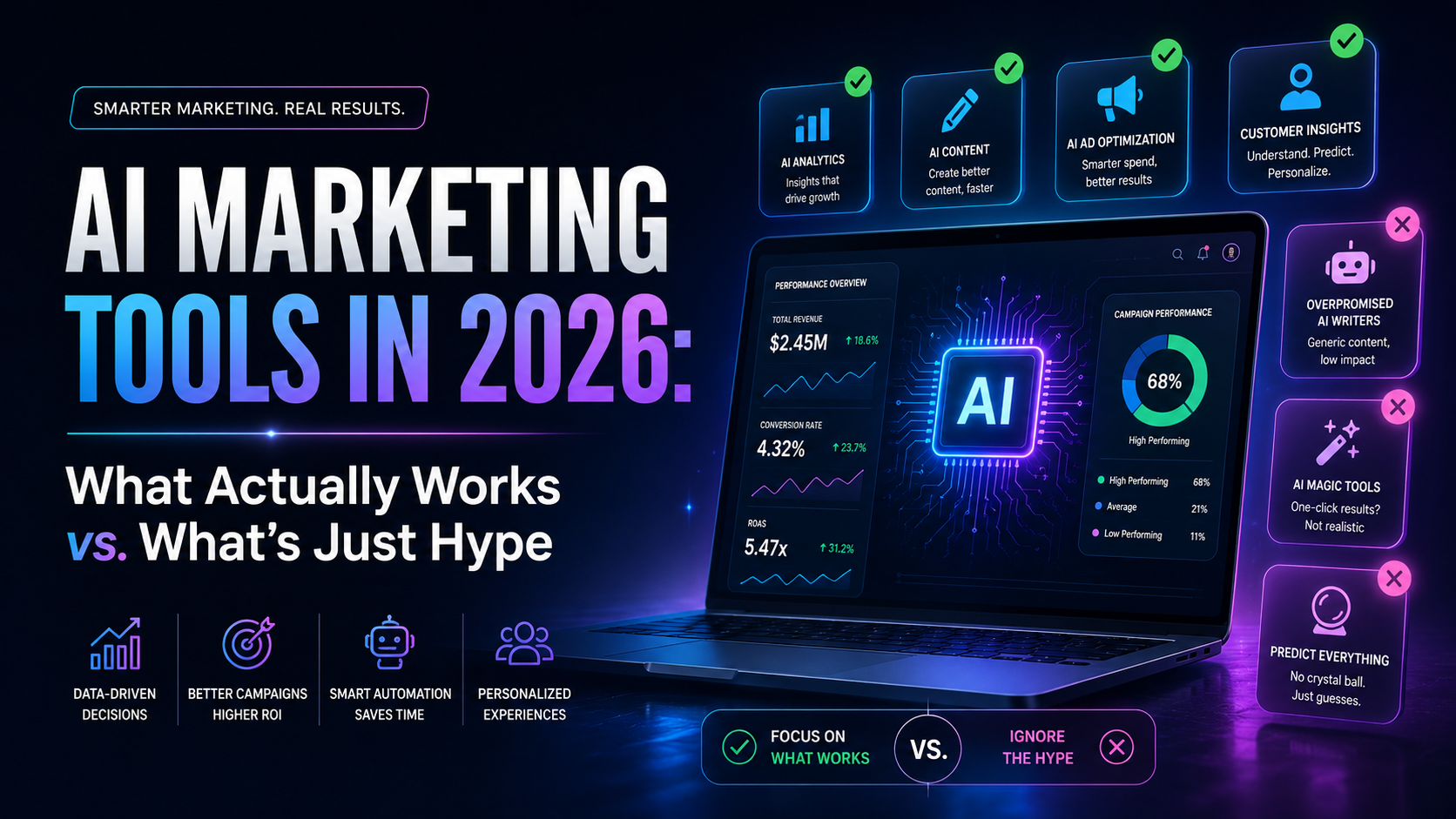
Every marketing conference in 2026 has a session on AI. Every SaaS tool has added an AI button. Every agency claims to be "AI-powered." The noise is deafening, and for marketers trying to build real results, it has become genuinely difficult to separate the tools that make a measurable difference from the ones that simply generate impressive demos.
We've spent the past year integrating AI tools across client campaigns in paid media, SEO, social, email, and content production. This is not a theoretical overview. These are our honest observations from real work, real budgets, and real performance data.
AI Tools That Actually Deliver Results
The tools that have genuinely moved performance metrics for our clients share a common trait: they augment human decision-making rather than try to replace it. The best AI in marketing is invisible - it makes good marketers faster and more precise, without removing the strategic thinking that drives results.
Predictive Audience Targeting in Paid Media
Google's Performance Max and Meta's Advantage+ have matured significantly. Both platforms now use machine learning to dynamically allocate budget across placements, audiences, and creatives in real time, at a scale and speed no human campaign manager can match. When fed with high-quality creative assets, clear conversion signals, and sufficient data volume (typically 50+ conversions per week), these systems outperform manual campaigns on cost per acquisition in the majority of cases we've tested. The human role shifts from bid management to creative strategy and signal quality - and that shift is worth embracing, not resisting.
AI-Assisted Content Briefs and Research
AI tools used at the research and planning stage of content production have proven genuinely valuable. Generating comprehensive topic outlines, identifying semantic gaps in existing content, summarising competitor coverage, and surfacing related questions people are searching for - these are tasks where AI saves hours and often surfaces angles a human researcher would miss. The key distinction: AI is producing the brief, not the final content. A subject-matter expert still writes and edits the article. This is the workflow that keeps quality high while meaningfully accelerating production.
Personalised Email Sequences
Dynamic email content - where product recommendations, send time, subject line variants, and even body copy adapt based on individual subscriber behaviour - has shown consistent uplift in open rates and click-through in our campaigns. Tools like Klaviyo and HubSpot have made this accessible without requiring custom development. The performance gains come from relevance: when an email reflects what someone actually browsed or purchased, engagement follows. AI enables this personalisation at scale; without it, it would require a team of copywriters per segment.
Automated Reporting and Anomaly Detection
Marketing teams lose significant time to manual reporting. AI-powered dashboards that pull cross-channel data, surface performance anomalies automatically, and flag campaigns drifting outside target KPIs free up analysts to focus on interpretation and action rather than data assembly. This is unglamorous but high-value - the teams using it consistently are making faster, better-informed decisions.
"The marketers winning with AI in 2026 are not the ones who delegated the most to it. They're the ones who identified precisely where human judgement creates diminishing returns, and handed only those tasks over."
- Roksana Miszczak, Digital Marketing Strategist at Pixelique Digital
What's Mostly Hype in 2026
Alongside the tools that deliver, there is a large and growing category of AI marketing products that generate impressive outputs but don't translate to business results. Identifying them matters, because every hour spent on tools that don't move the needle is an hour not spent on ones that do.
Before You Buy Another AI Tool
Ask one question: can you measure its direct impact on a business outcome - leads, revenue, retention - within 90 days? If the answer is unclear, the tool is probably optimising for impressiveness rather than performance.
Fully Automated AI Content Publishing
The promise of AI that autonomously researches, writes, and publishes articles at scale has proven to be a liability rather than an asset. Google's ongoing algorithm updates have become increasingly effective at identifying and demoting AI-generated content that lacks genuine expertise, original insight, or first-hand experience. Brands that went heavy on automated content publishing in 2024 and 2025 saw significant organic traffic declines. The lesson is clear: AI content without expert human review and enrichment creates more risk than opportunity.
AI Social Media "Managers"
Tools that claim to autonomously manage your social media presence - scheduling posts, responding to comments, generating captions - tend to produce content that is technically correct but tonally flat. Social media audiences are sensitive to authenticity. The brands with the strongest social performance in our network are those using AI to accelerate ideation and drafting while keeping a human voice in the final output and a real person monitoring conversations. Full automation of social interaction consistently underperforms.
AI-Generated Video at Scale
Synthetic video tools have improved dramatically, but for most marketing applications the results remain identifiable as AI-generated by audiences who've become attuned to the visual tells. For internal communications, explainer content, or markets where production cost is prohibitive, synthetic video has a role. As a substitute for authentic brand video in premium brand contexts, it is not there yet. Use it where authenticity is not a prerequisite; avoid it where it is.
A Simple Framework for Evaluating Any AI Tool
Given how quickly the landscape changes, individual tool recommendations age fast. More durable than any specific recommendation is a framework for evaluating whether an AI tool belongs in your stack:
- Does it augment a skilled human, or try to replace one? Tools that make expert practitioners faster consistently outperform tools that remove the expert from the loop.
- Is it optimising for an outcome you actually care about? Many AI tools optimise for engagement metrics (likes, open rates) that don't correlate with revenue. Identify the real business outcome first.
- Does it require quality inputs to produce quality outputs? The best AI tools reward strong strategy and penalise weak strategy. If a tool produces the same output regardless of strategic input, it is unlikely to be a competitive advantage.
- Can you measure its impact within a defined test period? Any tool worth the subscription should be able to demonstrate measurable impact in 60 to 90 days. If it can't be measured, it probably isn't working.
The brands growing fastest in the current environment are not the ones with the most AI tools. They're the ones with the clearest marketing strategy, using AI precisely where it creates compounding efficiency. If you want help identifying where AI can actually move your numbers, get in touch with our team - we'll give you a straight answer.
Where AI in Marketing Is Heading
The trajectory is clear: AI will take over more of the execution layer of marketing - creative testing, bidding, audience segmentation, personalisation at scale - while the strategic layer becomes more valuable, not less. The marketers and agencies that will thrive are those building deep expertise in strategy, positioning, and audience understanding, while using AI to execute that strategy more efficiently than was previously possible.
The risk is not that AI replaces good marketers. The risk is that brands cut corners on strategy, assuming AI will compensate - and find that AI amplifies weak strategy just as effectively as it amplifies strong strategy.
Invest in the thinking first. Use AI to scale the execution. That's the sequence that works.