

 United Arab Emirates

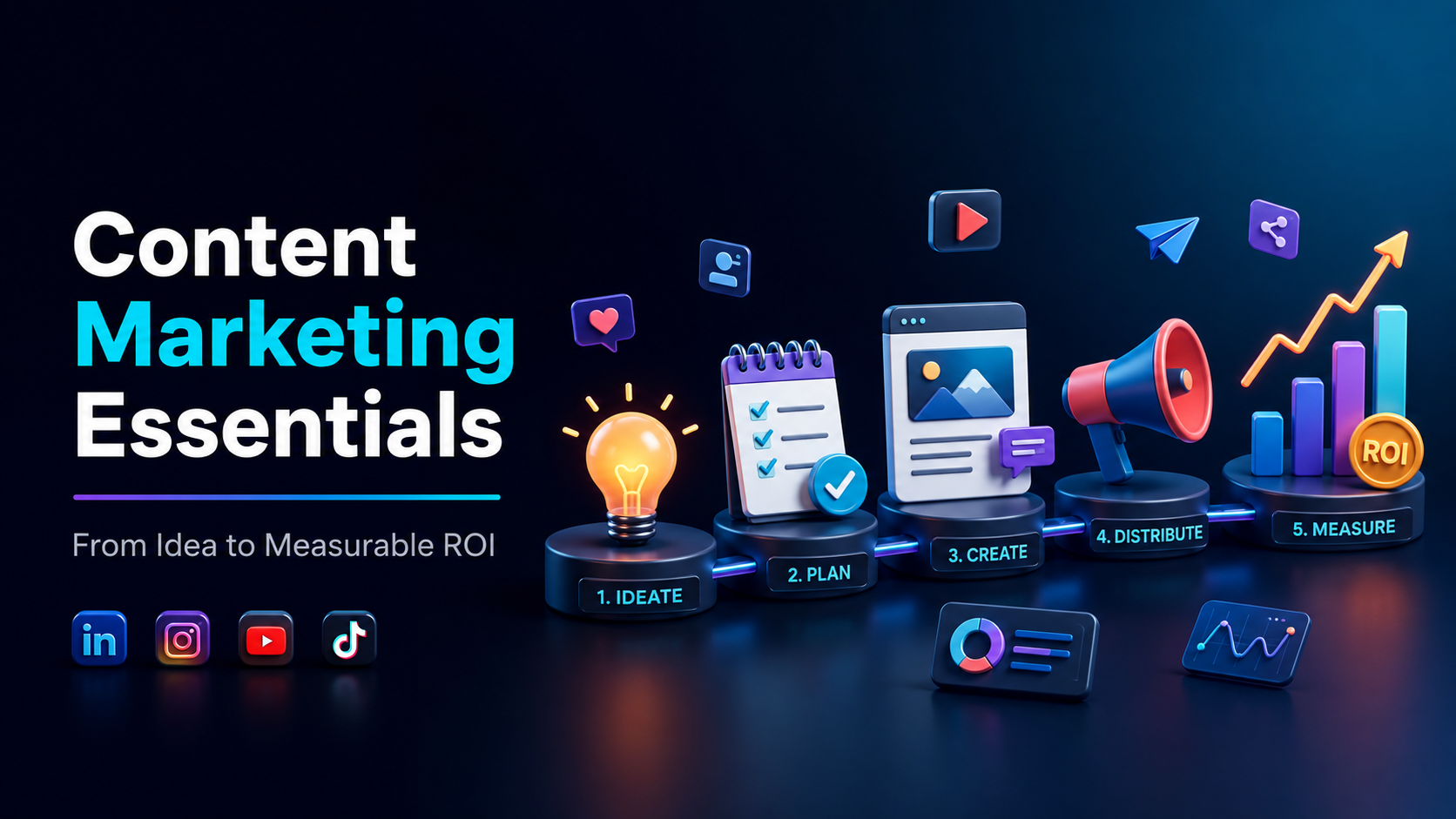
Content marketing ROI is one of the most misunderstood concepts in digital marketing. Most businesses that struggle with it are not struggling because content doesn't work, they are struggling because they have confused activity with strategy. Publishing blog posts, shooting videos, and posting on LinkedIn are all forms of content production. But without a deliberate strategy connecting each piece of content to a business outcome, all of that effort produces noise rather than results. The gap between brands that win with content and those that don't is almost never about talent or budget, it is about whether a coherent strategy exists at all.
In this guide, we walk through the core building blocks of a content marketing programme that actually moves the needle: from strategic foundation to format selection, measurement, distribution, and the long-term compounding effect that makes content the most durable channel in your marketing mix.
Why Most Content Marketing Fails Before It Even Starts
The majority of content marketing programmes fail at the strategic planning stage, before a single word is written. The most common failure mode is starting with the output rather than the outcome. A business decides they need "more content," assigns someone to write blog posts, and publishes irregularly on topics that feel relevant but have no documented connection to how the business acquires customers.
Without answers to foundational questions, content production becomes an expensive guessing game. Who is the content for, and at what stage of the buying journey? What keywords represent demand from buyers, not just browsers? What actions should a reader take after consuming each piece? How does this piece connect to the next in a coherent narrative? These are not abstract strategic questions, they are the practical decisions that determine whether content generates leads or sits unread.
Common Mistake
Publishing content without keyword research is one of the most costly errors in content marketing. Even brilliant writing generates zero organic traffic if no one is searching for the terms it targets. SEO intent research must come before content creation, not after.
A second failure mode is inconsistency. Content marketing has a compounding return structure, the value of a well-optimised piece of SEO content grows over months and years as it accumulates backlinks, improves in rankings, and generates long-tail traffic. Brands that publish intensely for three months and then go quiet destroy their own compounding before it can build. Consistency, even at a moderate cadence, outperforms sporadic bursts every time.
Building a Content Strategy That Aligns With Business Goals
A content strategy is a documented plan that connects content production decisions to business objectives. It defines who you are creating content for, what topics you will cover and why, what formats you will use, and how success will be measured. Without this document, every content decision is made in a vacuum and subject to the opinions of whoever is in the room that day.
Start by mapping the buyer journey for your primary customer segment. What questions do they have before they know they need what you offer? What are they searching for when they are actively evaluating solutions? What objections do they have at the point of decision? Each stage of this journey requires different content, awareness-stage content educates and attracts, consideration-stage content demonstrates expertise and differentiates, and decision-stage content converts.
Layer keyword research on top of this journey map. Use tools such as Ahrefs, Semrush, or Google Search Console to identify search terms with meaningful volume and achievable difficulty for each stage of the funnel. Every piece of content you produce should be mapped to at least one primary keyword and a cluster of related semantic terms. This is what allows your SEO strategy and your content programme to work as a unified system rather than two separate efforts.
If you want to discuss how to build a content strategy tailored to your business and audience, get in touch with our team, we work with brands across Europe and the Middle East to build content programmes that compound over time.
The Content Formats That Drive the Best Results
Not all content formats deliver equal returns, and the best format for any given piece of content depends on both your audience's preferences and your distribution channels. That said, the formats that consistently generate the strongest long-term results for most B2B and service businesses are long-form SEO articles, lead magnets, and case studies.
Long-Form SEO Articles
Comprehensive, well-structured articles of 1,500 words or more targeting specific search queries are the backbone of organic content marketing. They have the longest shelf life of any content format, accumulate authority over time, and can serve as pillar content that supports an entire topic cluster. Invest in depth, original insight, and clear structure, these are the signals that both readers and Google reward.
Case Studies and Client Stories
For service businesses, case studies are among the highest-converting pieces of content you can produce. They demonstrate credibility in context, answer the question "have you done this for someone like me?", and naturally incorporate the specific language your target buyers use when describing their problems. A single well-crafted case study can do more conversion work than a year of generic blog posts.
Video and Short-Form Content
Video content, particularly short-form video distributed via LinkedIn, YouTube, and Instagram, is increasingly important for brand authority and top-of-funnel awareness. It does not replace long-form written content; the two formats serve different stages of the buyer journey and different search behaviours. The most effective content programmes use both in an integrated way.
"The brands we see winning with content in 2025 are not producing the most, they are producing the most strategically. Every piece has a clear audience, a clear keyword target, and a clear next step for the reader."
- Roksana Miszczak, Digital Marketing Strategist at Pixelique Digital
How to Actually Measure Content Marketing ROI
Content marketing ROI is measurable, but it requires setting up the right tracking infrastructure before you publish, not after. The most common reason businesses conclude that content "doesn't work" is that they never built the measurement framework to see whether it was working or not.
The metrics that matter depend on your content goals. For awareness-stage content, track organic impressions, new users from organic search, and branded search volume growth. For consideration-stage content, track engagement metrics, time on page, scroll depth, and return visitors. For conversion-stage content, track goal completions: contact form submissions, demo requests, email sign-ups, and content downloads that initiate a lead nurture sequence.
- Connect Google Search Console to Google Analytics 4 to see exactly which queries are driving traffic to each piece of content and how those visitors behave on site
- Set up conversion events in GA4 for every micro and macro action that signals intent, not just final form submissions, but intermediate actions like clicking a CTA, spending more than two minutes on a page, or visiting your pricing page from a blog post
- Track content-influenced pipeline in your CRM, not just last-touch attribution, but whether content was consumed at any point in the customer journey before conversion
- Review ranking position trends monthly in Search Console or an SEO tool, upward ranking momentum is a leading indicator of future traffic and revenue growth
Measurement Tip
Don't evaluate content ROI over 30 days. The compounding nature of SEO content means the best return on a well-optimised article often arrives 6–18 months after publication, as it climbs the rankings and accumulates backlinks. Use 90-day and 12-month windows as your primary evaluation horizons.
Distribution: Where You Publish Matters as Much as What You Publish
A common misconception is that content marketing success is primarily about production quality. In reality, distribution strategy is equally important. You can write the best article in your industry and still reach almost no one if you have not built distribution channels to amplify it beyond organic search alone.
Owned distribution channels, your email list, social media following, and existing customer base, should be activated for every piece of content you publish. An email newsletter that surfaces new content to subscribers is one of the highest-ROI distribution mechanisms available, because it reaches an audience that has already expressed interest in what you have to say. If you do not have an email list yet, building one should be a priority before scaling content production.
Earned distribution, backlinks, social shares, and editorial coverage, amplifies reach and builds domain authority, which in turn improves the organic ranking of every piece of content you publish. Creating genuinely useful, data-rich, or original content that other sites want to reference is the most durable link acquisition strategy. Our content creation service is built around producing content that earns links and engagement naturally, not just content that fills a publishing calendar.
Paid distribution, promoting content via LinkedIn Ads, Meta, or Google Display, can accelerate results in the early stages of a content programme when organic reach is still building. Use paid promotion selectively for your highest-value pieces: cornerstone guides, case studies, and lead magnets that have clear conversion paths attached.
Turning Content Into a Compounding Growth Engine
The most powerful thing about content marketing, and the thing that makes it fundamentally different from paid advertising, is its compounding nature. A paid ad stops delivering the moment you stop paying. A well-optimised piece of SEO content continues to rank, attract visitors, and generate leads months and years after it was published. As your content library grows, the compounding effect accelerates: more content means more indexed pages, more ranking opportunities, stronger topical authority, and more internal linking pathways that distribute ranking power across your site.
Building a compounding content engine requires a long-term orientation and consistent investment. The brands that commit to content for 12 to 24 months before expecting significant ROI are the ones that eventually dominate their categories in organic search. The ones that give up at month four, when the results are not yet visible, never experience the inflection point where the investment starts paying back disproportionately.
To accelerate compounding, focus on building topical authority within defined subject areas rather than publishing on random topics. Search engines reward sites that demonstrate comprehensive expertise on a topic, a cluster of ten interlinked articles on a specific subject will outrank ten unrelated articles every time. Plan your content architecture around topic clusters, with a pillar page for each major theme and supporting articles addressing every related subtopic and question.
Finally, update and improve existing content regularly. A well-performing article that is refreshed with new data, expanded with additional depth, and re-optimised for current search intent will often see significant ranking and traffic improvements within weeks of the update. Content maintenance is one of the highest-ROI activities in any content programme, and one of the most neglected.