
 United Arab Emirates

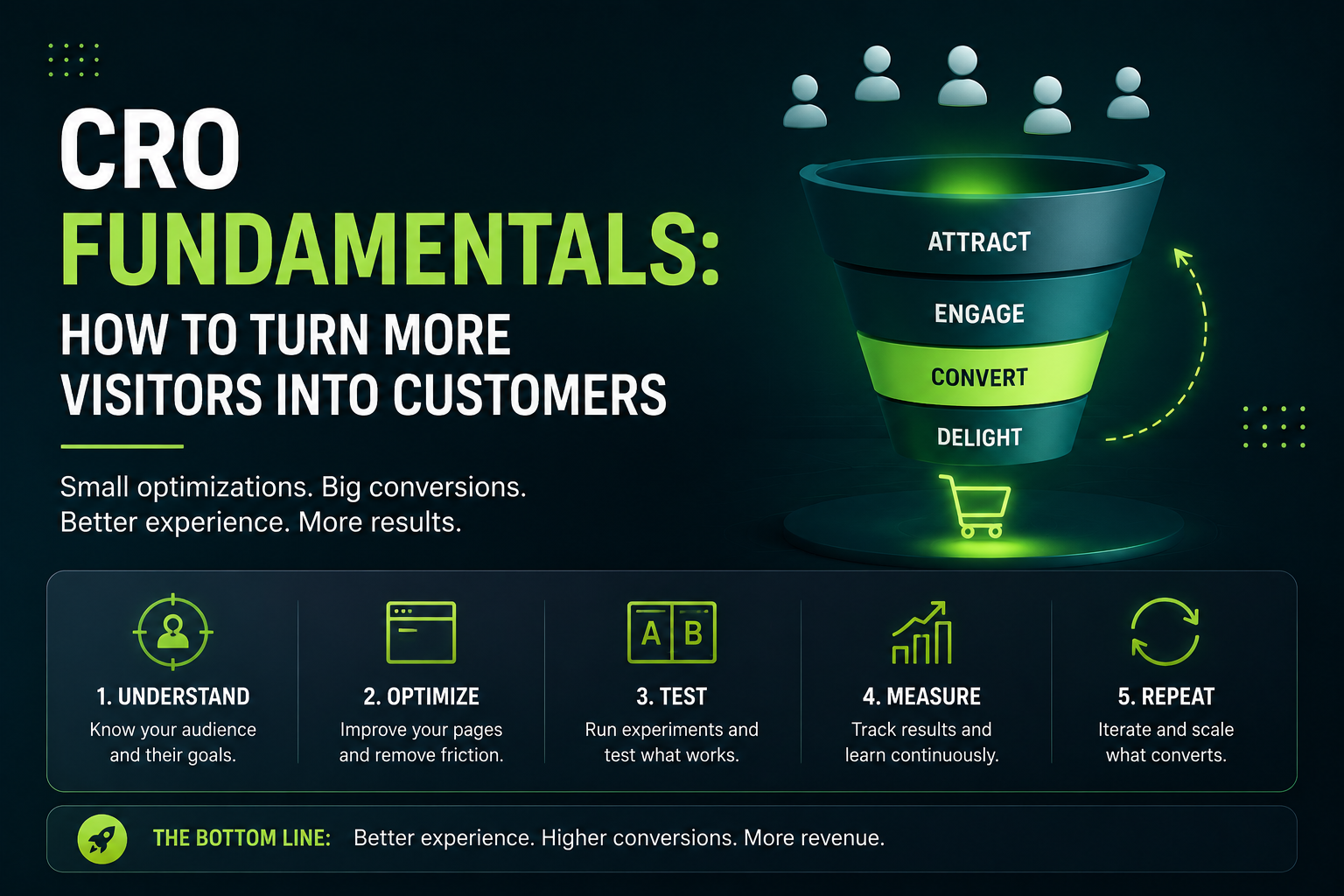
Most "conversion rate optimization" advice is either too vague to act on or so tactically narrow it loses sight of why CRO exists in the first place. CRO is not about button colours, exit-intent popups, or the latest A/B testing platform. It is about systematically removing the friction between a visitor's intent and your offer, and doing it in a way that compounds rather than producing one-off wins that fade after the first redesign.
Pixelique runs CRO programmes for service businesses, e-commerce stores, and SaaS platforms across Europe and the Middle East. The framework below is what we apply to every new engagement, and it consistently lifts conversion rates 30–60% within the first quarter, usually without redesigning the whole funnel.
What CRO Actually Is
Conversion rate optimization is the practice of systematically improving the percentage of visitors who complete a specific action, submit a lead form, complete a purchase, start a trial, book a call. The keyword is systematically. Random tweaks, gut-feel redesigns, and untested "best practices" pulled from blog posts are not CRO. They are decoration.
Real CRO has three properties. First, it is data-led: every change is grounded in observed user behaviour, not opinion. Second, it is hypothesis-driven: each test predicts a specific outcome based on a specific behavioural insight. Third, it is measured: every test produces a clear win, loss, or no-difference verdict that informs the next iteration. If your current "CRO" doesn't have all three, you are doing something else and calling it CRO.
Start With An Honest Audit
The biggest CRO mistake is jumping into testing before you understand where your funnel is actually leaking. We start every engagement with a structured audit covering quantitative analytics, session recordings, heatmaps, and a heuristic UX review. The goal is to identify the three or four highest-impact friction points, not to produce a fifty-page deck.
Common findings at this stage:
- Lead forms with seven fields collecting information nobody uses afterwards
- Mobile checkouts where the "next" button sits below the fold without any visual cue it exists
- Pricing pages that show numbers before communicating value
- Trust signals, testimonials, security badges, guarantees, buried below the fold
- Page load times so slow that bounce happens before content renders
None of these require a redesign. They require focused, testable changes, which is what makes CRO so high-ROI when done properly.
Where the Wins Hide
In our audits, the highest-impact friction is almost always in the "boring" parts of the funnel, the second pricing tier, the form's third question, the mobile cart icon. Glamorous redesigns rarely move the needle as much as fixing what's already there.
Forming Hypotheses Worth Testing
A weak hypothesis is "let's make the CTA button green and see what happens." A strong hypothesis specifies the user, the friction, the change, and the expected lift. Something like: "Mobile users on the pricing page bounce 73% before scrolling because the most affordable plan is third in a horizontal stack. If we reorder so the most affordable plan appears first on mobile, we expect plan-selection rate to improve by at least 15%."
Notice three things about that example. It identifies a specific user segment, it points to a specific behavioural data point, and it predicts a specific outcome. That makes it testable, falsifiable, and actionable regardless of which way the test goes. Hypotheses that don't have those properties produce results you can't learn from.
Running Tests That Mean Something
The two most common reasons CRO programmes produce unreliable results are insufficient sample size and stopping tests early. A test needs enough traffic and enough conversions to detect a meaningful difference with statistical confidence. For most service businesses, that means a single test typically needs to run for two to four weeks. Running for a week and concluding "we have a winner" is how you ship changes that don't actually work in the long run.
The other common failure is running too many tests at once. Concurrent tests can interfere with each other, especially if they touch the same step of the funnel. Discipline matters: one major test per funnel stage at a time, with proper sample size calculations done before the test starts, not retro-fitted to whatever data has already accumulated.
The Tools We Actually Use
You do not need a $40K/year platform to do CRO well. For most engagements we use Google Analytics 4 for quantitative data, Microsoft Clarity for free session recordings and heatmaps, and a lightweight A/B testing tool such as VWO or Optimizely for higher-traffic sites. Total tooling cost: usually under $200/month. The rest is process.
If you want a more thorough breakdown of how to set up the analytics foundation that makes all this possible, our CRO service includes the full instrumentation and process as part of every engagement.
The CRO Mistakes That Cost You Most
Three patterns we see repeatedly, in order of how much damage they typically do:
- Optimising for the wrong metric. If you optimise for lead form submissions but the leads don't convert to customers, you are celebrating noise. CRO must be tied to revenue or pipeline metrics, not just micro-conversions on the surface.
- Running tests without a stop condition. Tests should have a planned duration and a planned sample size, with rules for when to call a winner, loser, or no-result. Without those, you are cherry-picking the moment that flatters whichever direction you wanted to go.
- Treating CRO as a one-off project. CRO is a programme, not a project. The compounding wins come from running thirty tests over a year, not five tests in a quarter. Set up the rhythm and protect it.
"The biggest CRO unlock isn't a clever insight, it's discipline. Rigorous hypotheses, proper sample sizes, and a willingness to ship boring fixes that move the needle."
- Roksana Miszczak, Digital Marketing Strategist at Pixelique Digital
Getting Started Without a Big Team
If you do not have a dedicated CRO team, the right starting point is a single, focused engagement: a structured audit, a prioritised list of testable hypotheses, and one or two well-run tests in your highest-traffic funnel stage. From there you can build the cadence and decide whether to bring CRO in-house or keep running it as a partnered programme.
If you would like an outside perspective on where your conversion rate is leaking and what to test first, get in touch, we'll run a free initial audit and give you a prioritised list of opportunities, even if you don't end up working with us.

